Education is compulsory in the Netherlands between the ages of 5 and 16. The instruction language is Dutch, but more and more schools and universities teach in English.
Higher education
There are two types of higher education in the Netherlands: research-oriented and profession-oriented:
- Research-oriented education (wetenschappelijk onderwijs, WO) is traditionally offered by research universities.
- Higher professional education (hoger beroepsonderwijs, HBO) is offered by universities of applied sciences (hogescholen).
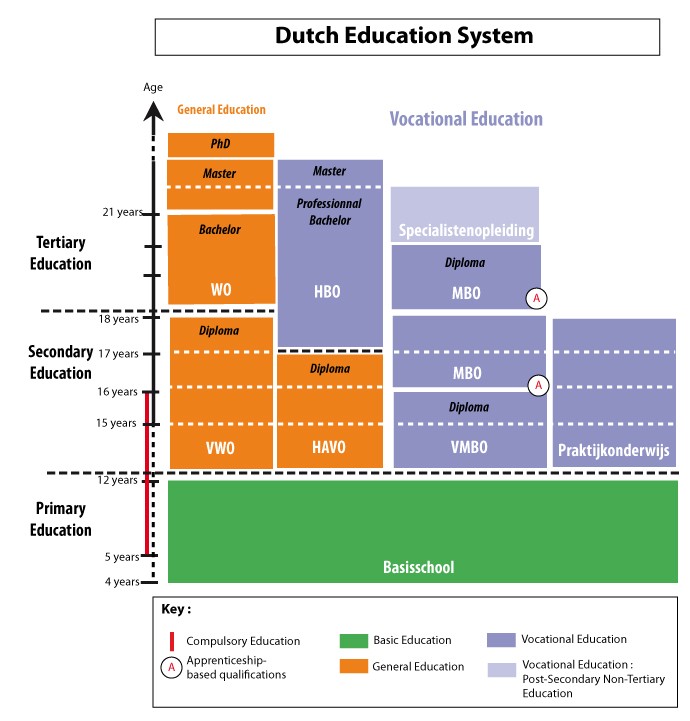
Programs at universities of applied sciences prepare students for particular professions and tend to be more practically-oriented. They lead to either a bachelor’s or master’s degree.
Programs at research universities focus on theoretical aspects of the field of study and prepare students for undertaking independent research. These also lead to a bachelor’s or master’s degree. At research universities, you can also pursue a Ph.D. degree.
Credit system and degrees
Degree programs and periods of study are quantified in terms of the European Credit Transfer and Accumulation System (ECTS). In this system, 60 credits represent one year of study and one credit represents 28 hours of study. The focus of the programs determines both the number of credits required to complete the program and the type of degree that is awarded:
Admission to higher education
For access to bachelor’s programs at research universities, you need a VWO secondary school diploma. Students who have completed the first year at a university of applied sciences are also eligible for admission. For access to bachelor’s programs at universities of applied sciences, the minimum requirement is a HAVO secondary school diploma.
For some programs, such as those in art education, the institution specifies additional skills as requirements for admission. Some study programs are bound by a numerus fixus, meaning there is a maximum number of first-year students they can admit.